Meno-Hochland
Together for the Meno-Highland

Restore the forestProtect the soilsDevelop the livelihood

For three decades, raising awareness about deforestation and soil erosion has gone hand in hand with implementing reforestation in grazing exclusion areas and other measures. The farming families need this support to continue living there.

30years of experience
3,000 mabove sea level
30,000people in the project area

From a friendship in Koblenz/Germany, a project emerged that provides direct assistance through volunteer work, donations, and trustworthy relationships, changing the landscape and lives in the Ethiopian highlands. Help to preserve and promote this.

Donate now for concrete measures
The project

Preserving Life in the Highlands

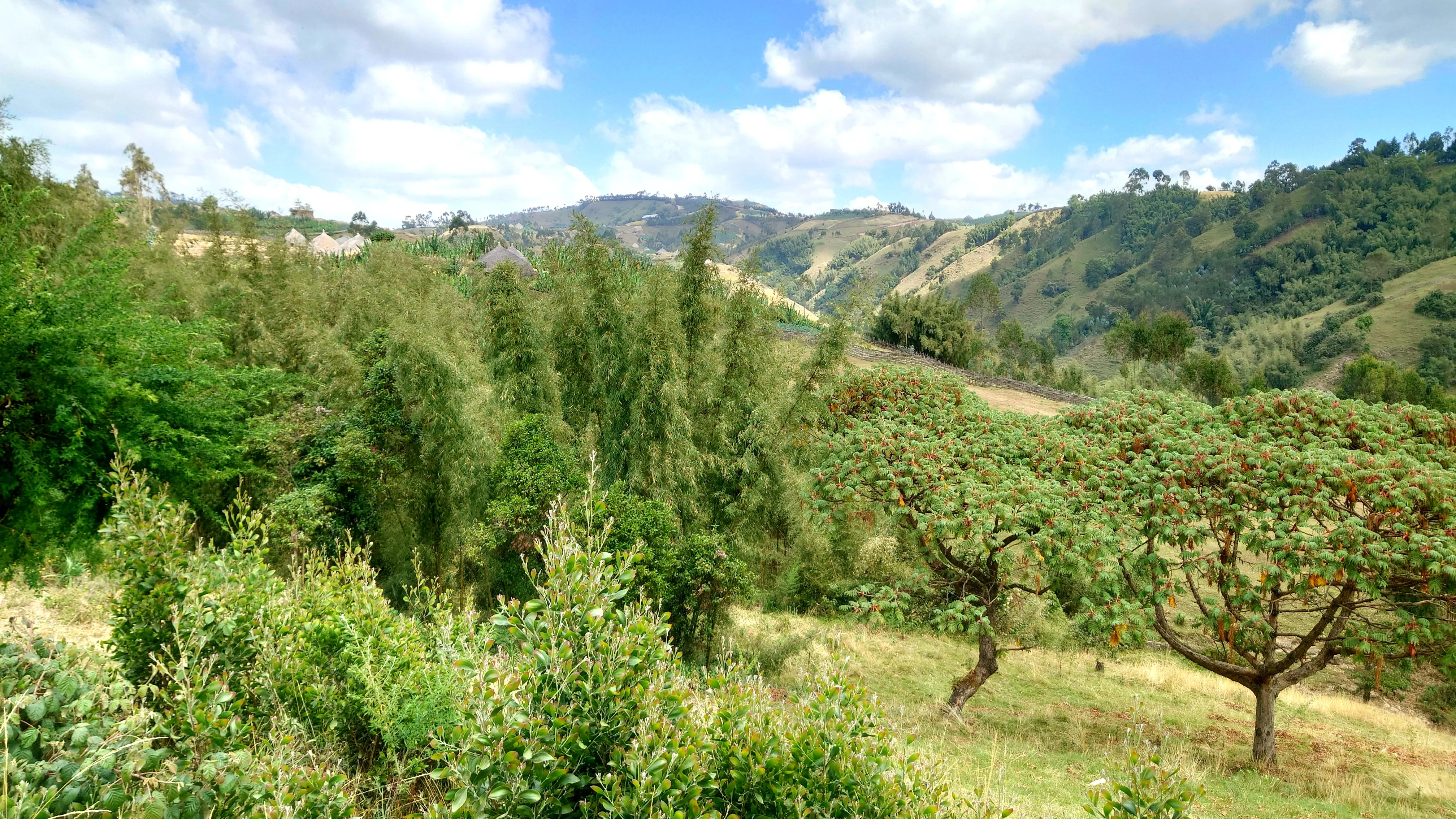
In the Meno Highlands, about 65 km southeast of Awassa (Sidama, Ethiopia), around 30,000 people live in six Kebeles (districts) at an altitude of about 3,000 m – without electricity. Deforestation, overgrazing, and soil erosion are depriving people of their livelihoods; climate change is accelerating this development.

We have been working against this since 1996 – carried by people on the ground such as project leader Dr. Denbeshu Debeko, who studied and earned his doctorate in environmental and animal sciences at Awassa University. Two farmer cooperatives and two nurseries were created, and many farmers have set up exclosures for reforestation with native trees. The project is currently in its fourth phase (2026–2030) and comprises several subprojects.

Our concept is a chain of measures: tree nurseries grow native seedlings; in grazing exclusion areas, they thrive and the vegetation recovers; cattle are kept on limited areas. This stops soil erosion and desertification. Crossbred Jersey cattle increase milk yield, with the vegetation, bees and honey return, and poor families receive heifers and beehives as a basis for their livelihood. Ermias Denbeshu reports directly from the highlands via smartphone.

Location
Meno Highlands, Sidama · 65 km southeast of Awassa
Altitude
2,900–3,200 m above sea level
People
~28,000 in 6 kebeles across ~190 km²
Climate
Two rainy seasons, ~2,000 mm, 10–15 °C
Farming
Ensete (False Banana), barley, and vegetables
Challenge
Overgrazing & deforestation → erosion
100.000 seedlings per year from two nurseries (Phase III, 2021–2025)
94 hectares of area exclosures established by farmers (Phases II + III)
30 years of commitment since our founding in 1996
Current: project phase IV (2026–2030)See the 8 building blocks
Discover more

Explore the whole project

Go deeper here – the highland and its change, the project phases, impressions and the association.

Donation campaigns

Four real ways to help now

Your help is needed – support one of our long-standing, successful subprojects. All four options were proposed by Ermias and the team on the ground; your contribution is calculated instantly.

Nursery
Keep the Soka Sonicho nursery running
For five years (2021–2026) the nursery raised around 50,000 seedlings a year for reforestation and environmental education. It has now stopped for lack of funds. €10,000 secures another season: donate €1 per seedling, which includes running costs and wages.
0 € / 10.000 €
seedlings
Tree species
Most needed right now: Juniperus procera, Hagenia abyssinica (endangered)
Goal: €10,000 for another season · €1 per seedling
* If we do not raise the money by October 2027, we will use it for planting in the Meno-Mollo nursery.
Your contribution0,00 €
Land protection
Enable an area exclosure
Severely overgrazed land only recovers when it is protected. In area exclosures, trees are to grow instead of fodder grass. Donate towards the lost fodder so that farmers can fence off their land for reforestation and still feed their livestock. Over 5 years one hectare yields grass fodder worth around 10,000 Birr (≈ €55). Donate an amount of your choice. From €1,000 in donations we start implementation, giving farmers a 5-year fodder guarantee.
Because grass prices have risen sharply, farmers are now giving up their area exclosures again to sell or feed the grass. That is why we need donors to counter this.
0 € / 1.000 €
Amount for fodder (€)
Starts at €1,000 in donations · €55 per hectare (5 years)
Your contribution0,00 €
Tree sponsorship
Sponsor a single tree
For smallholders without a larger plot: your seedling is fenced in and located by GPS, and you receive a growth report every year. €5 pays for 5 years of care and protection until it is robust.
trees
Tree species
Most needed right now: Juniperus procera, Hagenia abyssinica (endangered)
GPS location + annual growth report
€5 per tree (5 years)
Your contribution0,00 €
Cattle & income
Give a heifer, sheep or goat to a poor farming family, single people or the elderly
A cow means milk, nutrition and income. Recipients of a heifer are chosen by church elders, the cooperative and the Kebele administration. From €500 in donations, the animals are bought and distributed.
0 € / 500 €
Starts at €500 in donations
Amount (€)
A Jersey heifer costs around 40,000 Birr (≈ €220) locally, a sheep or goat around 15,000 Birr (≈ €85). The amount is up to you – we use it specifically to buy the animals.
Your contribution0,00 €

Amounts and tree species are based on proposals by Ermias and Harald (as of October 2026).

© 2026 Association for the Development of the Meno Highlands in Ethiopia (reg.) VR 3883 · Amtsgericht Koblenz